
AI assistant vs AI agent at work
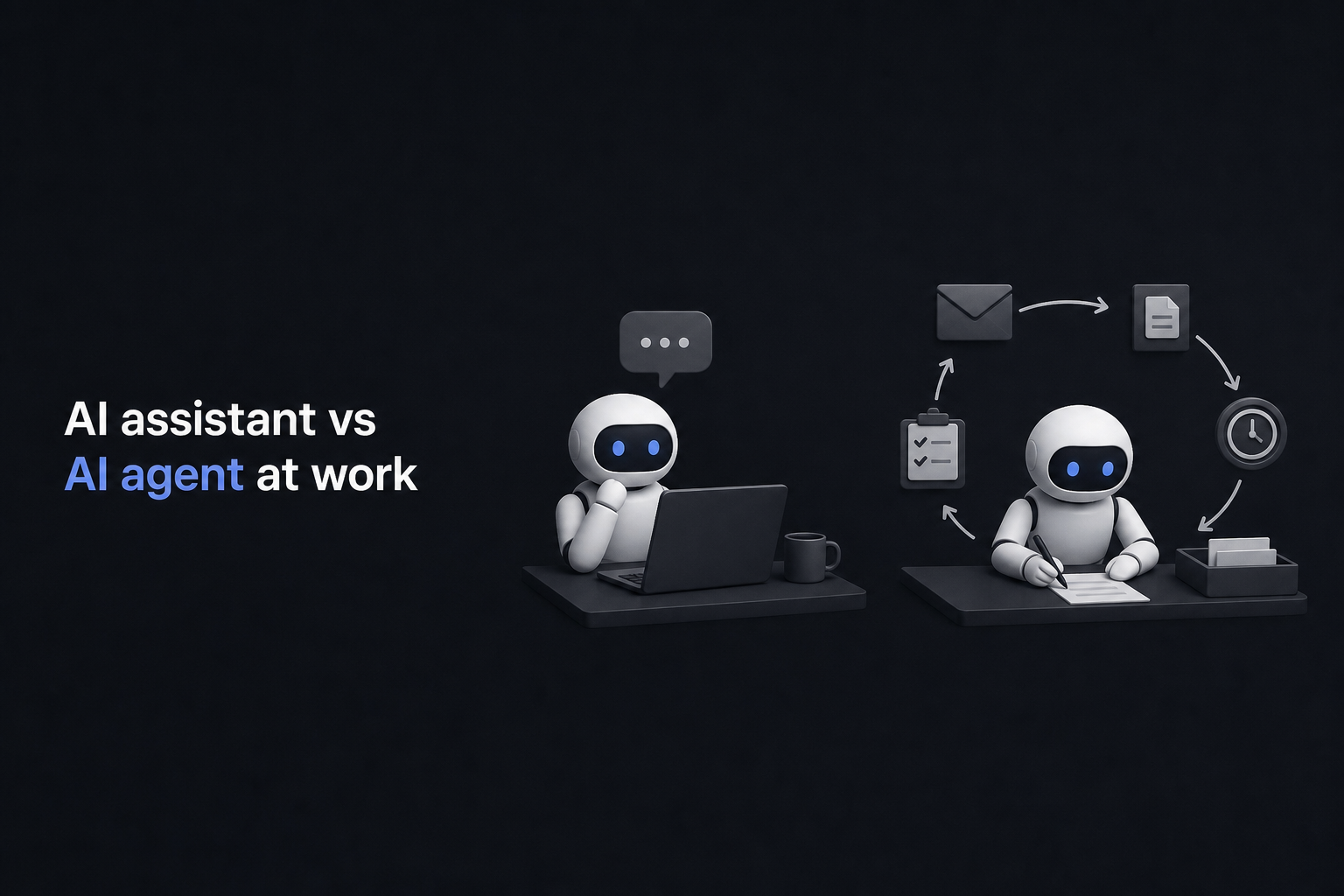
An AI assistant waits for a prompt. An AI agent runs a job you already defined. At work that is not a philosophy debate. A 30-person IT shop uses the assistant in company chat to ask the SOP. It uses the agent to fill Friday's form from inbound mail, then wait for a human. One is a conversation. The other is a run you can watch. Teams that mix them up either babysit a bot or wait for a chat that never starts the job.
Glean has been asking which works better. Dust has been building agents you treat like colleagues. Both are circling the same split. The operator version for an 8–80 person EU shop in August 2026 is simpler: pick the surface that matches the Tuesday, and keep both in the same company room.
What is an AI assistant at work, in practice?
It is a thread you open on purpose.
You have a question, a file, a half-written memo. You ask. You get a cited answer, a draft, a recap. You ask again. The assistant does not start at 09:00 because a rule said so. It starts because a person typed.
That is company chat when it is grounded in the company's documents. The SOP is in the workspace. The answer can point at it. A new hire can ask "how do we grant access here" and get the IT note, not last year's PDF from a personal upload.
Assistants are the right tool when the work is still a judgement. Which clause to tighten. Which of three outlines to take. What we told Müller last quarter. A person should be in that loop the whole time. If you try to make that an agent, you will spend the week writing exceptions for a job that was a conversation.
A 22-person legal shop lives here most of the day. The memo is not a form. The memo is a read. Chat is the assistant. The file stays in the matter. The partner comments in the same room.
What is an AI agent at work, in practice?
It is a job that already has a shape, running without a fresh pep talk.
Inbound mail with an order. The same confirmation template. The same blanks. You should not re-explain that on Friday. An agent reads the mail, fills the template, posts the draft, waits. That is automation, not a longer prompt.
Glean's "stop botsitting" line is the test. If you re-prompt the same job every morning, you do not have an agent. You have an assistant you are pretending is staff. Dust's colleague metaphor is useful for the brief you write once. It is a problem if it implies the agent can leave the building.
An agent at this size of company has four parts you can point at: a trigger, a workspace it is allowed to see, a template or skill, and a human on the action that leaves the company. Send, publish, refund, ticket close. Those wait.
If you cannot watch the run — what started, what it used, where it stopped — it is not an agent you can own. It is a script with better copy.
When does the assistant beat the agent?
When the input is messy in a new way.
New client. New exception. New "can we just this once". The 40-page PDF that is not last week's PDF. A partner who wants a colder read of the same email. That is chat. You want to see the reasoning in the thread. You want to switch the question. You do not want a workflow firing because someone CC'd the mailbox.
The assistant also beats the agent on day one of a practice. You do not know the job yet. You will write a bad agent if you automate the guess. Put the files in a workspace. Run ten real matters in company chat. Then look at which Tuesday repeated. That Tuesday is the agent candidate. The other nine stay as chat.
Ecommerce captioning looks like an agent from a slide. The first month it is an assistant: SKU sheet in the thread, three options, a human locking the line. Only when the caption job is the same every Monday do you promote it.
When do you actually need the agent?
When the team is already angry at the paste.
Same Word file. Same unstructured mail. Every Friday. Someone is the paste layer, and they know it. That is the job. File labeling if the output is the filled document. Automation if the output is a draft, a recap, a row, a post to the feed.
You also need the agent when the assistant cannot be the system of record. A private chat recap dies in one person's history. An agent that posts the recap to the workspace feed is the meeting, later. That is the same rule as humans and agents in the same feed: if it is not where the team looks, it did not happen.
A 15-person ops team needs the agent for order confirmations. They still need the assistant when a customer writes a novel in the signature. The agent drafts the 80%. A human in the thread does the 20% that is never in the template.
Do not start with "autonomous workforce". Start with one repeating Tuesday and a human on send.
How do both live in the same company room?
They share the files, the rules, and the people. They do not share a brain in a personal login.
Ops workspace. Template and last good confirmation in the files. Chat for the weird one. Agent for the mail that matches last week. The draft from the agent is visible in the same place a human would have pasted an assistant answer. A person approves. The send is the review.
Administration is what keeps this from becoming two more personal tools. Who may start a chat. Who may turn on an agent. Who may connect Gmail. If the assistant lives in Ana's ChatGPT and the agent lives in a Zap the intern connected, you have the old split with new nouns.
The room is the product. Assistant and agent are two ways to move work through it. When someone leaves, both stay, because neither was a tab named after them.
If you want a person in the room while you split the first job, book a half hour. Bring one task you still paste every Friday, and one question you still have to think about. Do not bring a blank stack diagram.
FAQ
What is the difference between an AI assistant and an AI agent at work?
An assistant waits for a prompt and stays in the conversation. An agent runs a defined job on a trigger, with a workspace it can see, and stops before the action that leaves the company. One is a thread. The other is a run you can watch.
Is an AI assistant or an AI agent better for a small company?
Neither, as a winner. An 8-person shop still has both jobs: questions that need judgement, and Fridays that repeat. Better means "which Tuesday is this". Chat for the memo. Agent for the form. The mistake is buying only one noun.
Can you use an AI assistant and an AI agent together?
Yes. That is the normal shape. The agent drafts from inbound mail. A human opens the draft in the same workspace and uses chat to fix the 20% the template never had. Then a human sends. Same files. Same room.
Do AI agents work without a prompt every time?
They should, once the job is defined. If you still have to paste the same brief every morning, you are botsitting an assistant. Triggers, templates, and a feed to post into are what make it an agent. Autonomy without a watch is not the goal.
Who should watch an AI agent at work?
Whoever already owns that job on a normal week. Ops for the order mailbox. IT for the runbook reply. A partner for anything that can reach a client. Watching is opening the run, not writing a longer prompt and hoping.
 DIMA
DIMA